Co-operatives 2017 Easter advertisement proves an issue in stereotypes and gender roles, with language affecting a young audience of women. The adverts message is visually more subtle than portraying a naked woman at the front of a poster or magazine cover, though the impact behind still hits as deep. Language is therefore the issue in this advertisement, indicating that women are of the duty that was embedded into the female sex 30-50 years ago, and should be raised that way, reinforcing typical stereotypes. Subtle messages contributing to the narrative behind the advert continue, indicated through the release of the advert, this being Easter time, where families and acts of cooking are involved. The advert links perfectly to the Easter occasion, ironically, and is an example that something as simple as language - with no visual editing or specific scenes of women can still have a powerful impact. Advertisements like this further contribute to gender theories Judith Butler has,the theory stating that gender is not a result of nature, but socially constructed. Forms of media that continuously place women in an unequal, stereotypical position over generations constructs what others see the specific gender as with the associated behaviours. Though the advert proves Butlers theory, the time period at which it has been advertised contradicts other theories, such as fourth wave feminism. Fourth wave feminism began from 2013 with an impact created from the use of social media, encountering platforms such as Instagram, Twitter, Tumblr, Youtube etc. The feminists within this wave are see as quite lazy in comparison to generations ago, the idea that the only 'impact' they make s through tweeting or posting only for their specific audience to view, for example, however one could argue that social media is a powerful and global use, raising awareness and educating people across the world, if said posts were to trend.
The time period being 2017, the generation into fourth wave and post feminism with a huge increase of social media use, this advert still proves to be damaging, and does not symbolise equality and the abolishment of feminism, though some may argue it’s the ignorance of admitting post feminism is in full force, forcing women back into few rights they used to have.


Another form of media which is provocative to the female gender is the weight loss poster by Protein World. The main focus is a woman's slim body, composed in the middle of the poster in the foreground. The language "beach body" gives into the idea that the females slim figure is the definition of looking perfect for the "beach" and proves Judith's Butler's theory. Butlers theory suggests that gender is not the study of nature, rather it is socially constructed. Gatekeepers have control over all media outputs. Decisions made by them therefore reach large spreads of audiences. and by portraying women in a thin, appealing way, the audience is indoctrinated to believe females in real life should appear like this. Advertising like this for generations and developing the 'male gaze,' society has constructed set values for what a woman should be, supporting Butlers theory. Following on from this, the 'male gaze' is a theory presented by film theorist Laura Mulvey, stating that women are seen from a heterosexual, male point of view in film/media & Mulvey discusses this in her book "visual pleasure." Male gaze applies within this advert - a half naked, attractive woman would be of the likes of males, making the product overall pleasing from their point of view and making audiences view the advert from the liking of heterosexual males.
Post feminism is generally considered to be 3rd and 4th wave feminism, which begun in the 1990's. The word ‘post’ suggests that feminism isn’t relevant anymore because women have won equal rights.
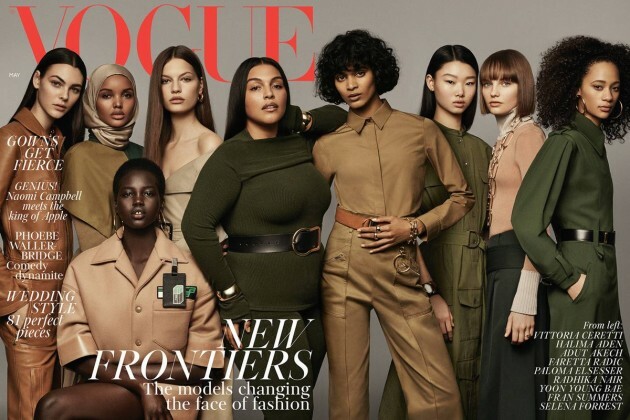
Vogue’s 2017 “new frontiers” advertisement is an example of gender roles that have been abolished in the modern day, and can be associated to the theory of post feminism.
Post feminism is a concept used to describe the state of feminism after it has been “abolished” The norms of the theory defer to previous waves, and state that many goals of feminism have already been fulfilled, meaning any further movements to bring women equality are not valid - women have gained equality. The models advertised are of various skin tones representing separate cultures, also linking to Crenshaw's intersectionality theory. The intersectionality theory suggested that there is inequality in feminism caused by more than one individual identity, for example being black and a woman. The power of political movements and global metacommunication on social media allowing post feminism has further allowed a decrease in intersectionality, as evident in this advertisement with the overlapping mix of culture and gender. Unlike previous forms of media before post feminism from 1990’s onwards, the women in this advertisement are wearing clothing that is not objective or provoking, in comparison to advertisements that would exploit the female gender by showing women half naked and in bright, vibrant colours, such as pink. Visuals were used to please audiences, in particular men, reinforcing the statement ‘sex sells.’ Compositions of the text are simple and not out of balance as well as the colour, allowing full attention on the women and the composition is not inappropriate/ out of balance. We as an audience are not distracted by what the fashion magazine are promoting - this being their clothes, which are visually evident. Text such as “the models changing the new face of fashion” can further be interpreted as an indication of post feminism, language such as “changing” and “new.” Vogue's audience and issue of this magazine may have also reached to a wider spread of audience, possibly from new cultures.


No comments:
Post a Comment